

%20(2).png)
Every investment team we spoke to operates some version of the same funnel: a large volume of inbound and sourced opportunities, a fast early filter, and a small number of deals that ever receive full diligence. At many funds, the ratio approaches one hundred opportunities reviewed for every deal closed; at others, fifteen to twenty leads a month are narrowed to a handful worth a second look. The ratio varies considerably by strategy and sourcing model. The shape does not.
What varies less than one might expect, however, is where the hours actually go. And it is not where the popular image of due diligence suggests!
Over the past months, we conducted a structured discovery programme with investment professionals across Europe and beyond: deep, semi-structured conversations spanning the full breadth of private capital. The sample included buyout PE from lean mid-market teams to multi-fund platforms managing billions, venture capital from pre-seed to Series B, private debt and mezzanine, infrastructure and project finance, government-backed funds, and family offices investing their own capital. We spoke with junior and senior analysts, investment managers and directors, general partners, principals and operating executives. In this post, we walk through the top 10 lessons that most changed our understanding of how deal screening and due diligence actually works.
Top 10 Key Lessons Learned
1. The deal is decided in the first week… long before the full memo
The popular image of due diligence is the deep dive: the six-week review, the 50-page memo, the data-room marathon. The operational reality we received is different. The decisive moment in most deals comes much earlier, in an initial screening pass that determines whether the opportunity deserves further attention at all. One buyout analyst told us his fund makes its go/no-go call after roughly a week of reading the information memorandum and a single advisor call — and estimated that 90% of decisions are effectively made at that point. Funds with formal multi-stage processes confirmed the same structure: a binary gate at stage one, with full diligence reserved for the small number of deals that pass it.
This has a structural implication for anyone thinking about where technology can help. The highest-frequency, highest-leverage artifact in private markets is not the final investment committee memo, which is only produced for deals late in the funnel. It is the screening memo — the short, dense document produced for every deal that clears the first filter. That is where a firm's screening capacity is actually spent, and where it is won or lost.
2. The bottleneck is not understanding the data. It’s building conviction.
We began this research assuming the core pain was document ingestion: parsing data rooms, extracting figures. The interviews corrected that assumption. The scarce resource in due diligence is not information (most teams have more of it than they can process !) but trust in the information, and producing trust in delegated intelligence is a slow and expensive process.
Consider what has to happen before an investment case reaches a committee. Someone must extract the numbers, reconcile them across sources that rarely agree, cross-check every market claim, chase down inconsistencies, and then compress all of it into a document they are prepared to defend under adversarial questioning. Very little of this work is creative; most of it is assembly and verification. As one former growth-equity investor described it:
"A lot of it is about organizing and sequencing information as opposed to doing anything from scratch... and oftentimes you end up copy-pasting. That is the reality.", former Growth Equity investor, 15 years in PE
The time estimates we heard converge on the same order of magnitude regardless of fund type: analysts describing 80% of their week spent on document work and 20% on actual strategy; one buyout team assigning a managing partner and two junior professionals to a single deal's documentation for roughly a month; a senior director at a private-debt fund quantifying the translation of heterogeneous financial statements alone:
"300 companies, one hour per company. 300 hours.", Senior Investment Director, private-debt fund
Each of these accounts describes the same underlying cost: the distance between raw data and defensible conviction. One partner-level investor at a large multi-fund platform framed the goal of closing that distance in practical terms: less time on documentation, more time visiting entrepreneurs and building the relationships through which deals are actually best influenced.
The conversations also clarified where that conviction accumulates. The memo process is not linear, and no two firms run it identically. Nevertheless, a representative model emerged consistently across fund types:
Conviction is built in the memo: a living decision artifact that starts thin and deepens as information arrives. In its typical form, it begins as a screening memo, the internal document on which the team or an early IC review decides whether a deal deserves real attention. It matures into the IC memo, the version on which the firm makes its commitment decision. And it culminates in the final memo, which absorbs external diligence findings, term sheets, and transaction details into the definitive record of why the deal was done. At firms with mature processes, the same artifact continues to serve after close: the investment memo is the natural starting point for the value creation strategy, and eventually for the exit memo that documents the transaction and reflects on the investment from first screen to sale. Understood this way, the memo is not paperwork produced around a decision. It’s the institution's memory of the deal.
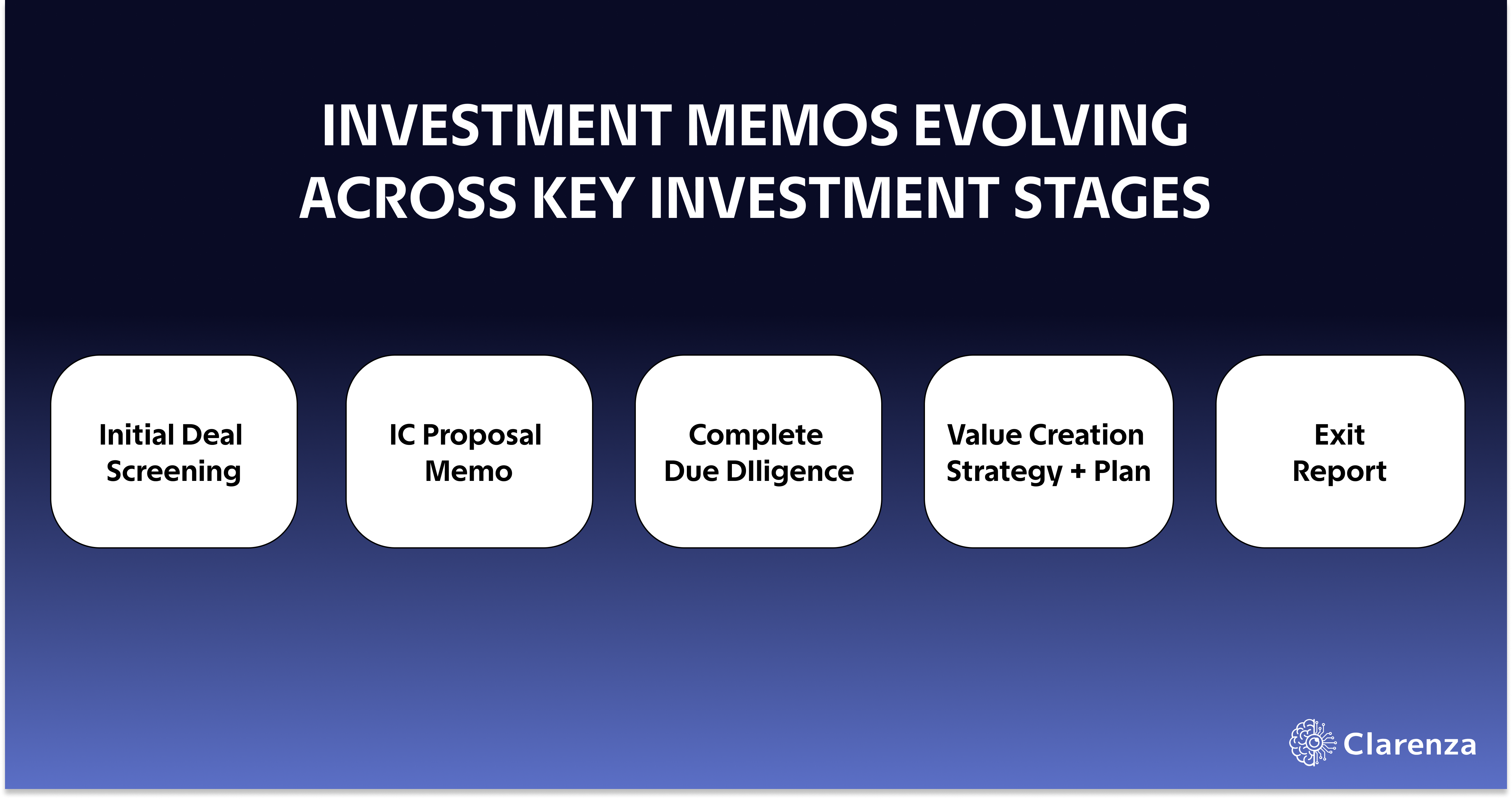
This framing raises a design question we are still actively researching: how should investment intelligence be designed to enhance human decision-making? That question, more than any individual feature request, is what this research programme handed us.
3. Decision artifacts are rebuilt several times over
Producing the analysis once is not the end of the work. Across fund types, teams described a second, purely mechanical layer: rebuilding the same decision artifact into every format their internal process requires. The text-heavy Word memo is converted into a chart-heavy PowerPoint deck (almost always fitted into a fixed internal template), slide by slide, to match the fund's visual standards. The underlying analysis is then repackaged as an information pack: an Excel workbook recapping every attached exhibit and workstream so the committee has a single navigable reference. The content, the numbers, and the conclusions are identical each time. Only the presentation and format changes, and that conversion is done by hand today.
This is worth examining closely, because the nature of the cost is somewhat unusual. Most inefficiencies in a workflow at least produce some byproduct of value along the way. This one does not. Reformatting the key insights step does not add a new fact, a new figure, or a new conclusion to the deal. The content, the numbers, and the analysis were already finalized before the rebuilding began. What it consumes is analyst time, that is, by the participants' own account, disproportionate to what it contributes, and it is where several of the most experienced professionals we met located their frustration. One investment manager with twelve years across PE and VC named it, unprompted, as his single biggest pain:
"For me, the biggest challenge was PowerPoint. I wasted so much time on PowerPoint presentations just for internal presentations, which makes no sense at all. You are not a consulting company.", Investment Manager, buyout fund
And because the memo is a living artifact, evolving from screening memo to IC memo to final memo as conviction deepens, this rebuild cost is not paid once. It recurs at every stage of the memo's evolution: each new layer of analysis triggers a fresh round of template slides and recap workbooks. The overhead compounds at exactly the points in the process where analytical attention matters most and knowledge equity is underutilized.
4. Data preparation is the invisible tax on every deal
Before any model can be built or any memo written, someone has to make heterogeneous data comparable, and teams across every fund type described this as a persistent, granular drain that rarely appears in any formal accounting of diligence time. Financial statements arrive in dozens of formats with inconsistent line-item classifications. Information lands, in one operating executive's words, in "dribs and drabs," creating a long back-and-forth over basic metric definitions. Buyout teams described repeated rounds of communication with target-company CFOs simply to classify cost lines consistently enough for a comparison model to be meaningful. A family office noted that even public financial filings arrive one to two years delayed in its home market, so the baseline data itself cannot be taken at face value. Others described the unglamorous preparatory work of sorting a data room (eg. establishing wich document relates to which) before analysis can begin at all.
One nuance is worth drawing out, because it shapes what a sensible solution looks like. No one asked us to replace their financial model. Excel is universal in this industry; the modelling itself is generally not the complaint, and analysts have well-founded reasons to want full control over their own model logic. Effectively, the model usually encodes the specific way a team thinks about a business, and that logic is not something most teams want to hand over to a black box. The complaint is narrower and more specific. It is the data-gathering and classification work that has to happen before the model can be built, where the same underlying facts have to be pulled from inconsistent sources and mapped onto a consistent set of definitions before any comparison across companies or deals becomes possible.
"Our finance team is 110% manual at the moment. They have no automation. They run everything end-to-end on Excel. It's really tedious.", AI Lead, mezzanine-debt investor
The opportunity is not to replace the analyst's model, but to feed it accurately, consistently, and with every classification decision visible and reviewable.
5. Market research as automated enrichment. Most common AI entry point
Ask investment professionals where AI already helps them today, and the answer is nearly unanimous: market and competitive research. The reasons are instructive. The work is repetitive, it runs on public rather than confidential data, and it is perceived as preparatory groundwork rather than judgment. 3 properties that make it the lowest-friction, lowest-risk place to introduce AI into an investment workflow. The same logic applies upstream in sourcing: teams that proactively build pipelines from public registries and professional networks described list-building as labour-intensive enough to crowd out the direct engagement with targets it is supposed to enable.
The current experience, however, carries a hidden cost that several participants quantified in time. A family-office investor named his single most time-consuming task not as the data preparation itself, but as cross-checking AI-generated research or manually verifying outputs against sources to catch hallucinations and outdated data. The pattern is worth noting because it recurs throughout these findings. Teams that adopt general-purpose AI to save time frequently spend a meaningful share of the saved time auditing the AI's output. Whether that trade is worthwhile depends entirely on how verifiable the output is (a point we return to in lesson 8).
6. Ungoverned AI use is already the de facto standard
Across the conversations, one pattern repeated consistently: individual professionals are using consumer AI tools (general-purpose chatbots and assistants) on live deal work, without team-level frameworks, data governance controls and preferences, or source traceability features. The most detailed version came from junior analysts, several of whom described essentially the same improvised workflow: paste the contents of the deal room into ChatGPT, Copilot, or Gemini; run it against a self-built, prompt-based risk-screening framework; and use the output as a first-pass screen, or as preparation for the questions a partner or a management team is likely to ask during intro calls or internally at IC. In at least one case, an analyst acknowledged uploading confidential due-diligence documents to a public AI tool without authorisation, understanding the risk involved. Others described running standardized question sets through consumer chatbots on business models and technology as a routine part of screening.
The significance is easy to understate. Deal-room contents are strictly NDA-bound and subject to LP confidentiality obligations. In these workflows, this sensitive dataset is being processed by consumer services, evaluated against frameworks each analyst constructs individually in a prompt (and limited context) window, with no institutional record of what was shared or how conclusions were reached and no transparency on reasoning chains and sources.
At the same time, formally sanctioned adoption tends to stop at a visible trust boundary. At one large buyout platform, an enterprise AI assistant is deployed firm-wide, but its use is limited to administrative tasks! No one drafts investment documents with it. The distance between what analysts do informally and what firms permit formally is precisely where confidential material is most exposed today. AI adoption in private markets is happening bottom-up, analyst by analyst, ahead of the governance designed to contain it.
7. Confidentiality, IP retention, and AI governance. Top of Agenda.
The teams we spoke to are not unaware of the risk described above, and their concerns, examined closely, separate into 3 distinct layers that are worth distinguishing because they demand different answers.
- Confidentiality in the conventional sense: deal data is bound by NDAs and LP obligations, and firms cannot state with certainty where that data goes, or how long it persists, once it enters a consumer AI tool.
- Investment IP: a firm's thesis, screening logic, and analytical frameworks constitute much of its competitive edge, and feeding them into external models that may retain them (or train on them) leads to an uncontrolled transfer of that edge.
- Governance Capability: whether the firm could demonstrate compliance even if asked. One VC firm is now drafting an internal charter on appropriate tool usage. A partner at a large platform, asked whether his firm could guarantee GDPR-compliant deletion of personal data held by its own external IT provider, and acknowledged that he could not say for certain.
The response we heard consistently across segments is a hardening infrastructure requirement: European data sovereignty. For a government-backed fund, an infrastructure investor, family offices, and mid-market firms alike, independence from US cloud providers for anything touching deal data has moved from a preference to a stated purchasing criterion (in one investor's words, "a critical requirement”). For teams evaluating tools in this category, it is worth understanding that this is a gating condition that determines which solutions should be considered at all.
8. Trust in AI has a precise, technical definition: Provenance
When investment professionals say they do not trust AI, it is tempting to read this as generalised caution. The interviews suggest something more specific. Across fund types, participants articulated the same concrete requirement: every figure a system produces must be traceable to its exact source, and derived values must never be confused with source values. An investment director at an infrastructure fund explained the distinction precisely:
"Being able to identify very quickly what is the hard black value that comes from a credible institution versus what has been derived from that — it cannot be mixed up. I would get very paranoid.", Investment Director, infrastructure fund
The reason this requirement is so firm becomes clear when you consider how the memo is used. It is simultaneously an internal decision instrument and an external credibility signal to committees, and, ultimately, to LPs. Committee members probe memos to verify that the analyst did the work; a figure that cannot be traced to its origin cannot be defended in that setting, whatever its accuracy. This is why provenance functions as a threshold criterion rather than a differentiator: no gain in speed, summarisation quality, or formatting offsets a number without a verifiable source. Any AI system intended for investment decisions has to clear this bar before its other qualities become relevant.
9. "Chat with your Docs" vs Proactive AI-assisted decision-making tools
Of all the findings, this one does the most to explain why the problems in lessons 5 through 8 persist despite an increasingly crowded market. There is no shortage of tools that let a user ask questions of a data room (the capability has become a commodity), available in general-purpose chatbots and in vertical due-diligence products alike. Yet the teams that went looking for something they could actually adopt generally came back empty-handed. One experienced buyout investor told us he searched specifically for a dedicated PE tool and could not find one; a family office that evaluated the vendor landscape concluded that nothing available was mature enough for real deal work.
The gap they described is worth stating carefully, because it is a gap in the interaction model rather than in feature count. Chat is passive: it answers what it is asked, which makes it only as good as the analyst's next question… and it leaves the hardest parts of the job untouched. What no team could find is an AI-native tool that behaves like a capable colleague: one that proposes the key questions to put to management, flags the inconsistencies worth chasing, recommends the next diligence steps, and drafts the questionnaire rather than waiting to be prompted. A second dimension of the gap is collaboration. Today's tools are essentially single-player, in a fundamentally collaborative workflow: research still circulates as Word attachments over email; committees are adversarial by design, and memos are meant to be challenged days before the meeting rather than presented cold at it; one family office described its three members dividing every deal so that one leads and the others run sanity checks, a review pattern no tool they had seen supported.
Underneath both dimensions sits a consistent design constraint: control. Nearly every investor drew the same line about where automation should stop. A family-office director was direct and shared, “A good management team with a mediocre company can be a strong investment; the reverse rarely is”. A partner at a multi-fund platform listed "soft items" around the entrepreneur's competence among his primary disqualification criteria, while noting that leadership assessment has the weakest data support of any diligence workstream. What these teams described wanting is not a verdict from a machine, but an assistant that surfaces structured, traceable, challengeable evidence and better questions, while the analyst remains and demonstrably feels, always in control of every judgment. As far as our research could establish, no tool meeting that description was already in use at any of the firms we spoke with. Lean teams absorb the cost. Large funds pay to outsource it.
Not every finding in this programme pointed in the same direction, and the disconfirming evidence is worth reporting alongside the rest. At large, well-structured funds, the document chaos described in earlier lessons is absorbed by an external ecosystem: sell-side advisors structure the information, Big Four teams run the diligence workstreams, and the internal deal team orchestrates rather than analyzes. As one investment manager at a large buyout fund told us, from a documentation standpoint, it "wasn't super troublesome," because the advisor "takes care of making everything nice, smooth, structured."
That buffer, however, has a price that participants quantified for us. External diligence engagements were quoted at up to millions of euros per deal, exceeding €150,000 per week on large transactions, and up to €700,000 for full-scope reviews (before legal costs). And at lean mid-market funds, family offices, and small deal teams, there is no buffer at all: the analysts absorb everything, on every deal, at every stage of the funnel.
The pattern, stated generally: pain severity is inversely related to advisor budget. One end of the market carries the manual burden directly; the other pays advisory fees that would fund an entire analyst team to avoid carrying it. Both are, in effect, paying for the same thing through different mechanisms (one in analyst hours, the other in advisor invoices), which suggests that the underlying cost of building conviction on a deal is fairly constant, and what differs is simply who absorbs it and in what form.
What These Lessons Shape and Where They Point Next
This research was not designed to validate a predetermined feature set, and the findings above are presented as findings, not as marketing claims. At the same time, it would be misleading to describe them as open questions from our side: each has directly informed decisions already made in the platform now entering closed beta. For anyone evaluating this category of tooling, the mapping from lesson to design decision may be the most concretely useful learning of all:
- The first-week decision and the cost of conviction are why the platform's first job is turning a raw data room into a structured, decision-ready screening memo in minutes rather than days.
- The rebuild cost is why outputs adapt to each firm's own structure, templates, tone, and reporting standards rather than imposing ours. This way, the analysis is produced once, and the formats follow from it, not the other way around.
- The standardisation tax is why extraction is built for high fidelity across financials, (tables, charts, and narrative) and built to feed the analyst's own model rather than replace it.
- The verification burden is why every extracted figure carries full source traceability. An analyst can click through to the original document, page, and coordinates and verify it immediately. A number without a reviewed source is meaningless
- The governance and sovereignty findings are why the platform runs on European infrastructure with strict retention policies, no third-party access, and encryption (at rest and in transit) and why client data is never used to train models. A firm's investment in IP remains its own.
- The assistant gap is why the platform was never designed as another chat window over a data room. It works ahead of the analyst, surfacing key risks and the devil's advocate case unprompted, flagging what is missing, and generating the diligence questions to put to management, while the analyst stays in complete control. Evidence and better questions come from the same system. Every judgment, demonstrably, from the human.
- And where the research points beyond what exists today, we would rather say so plainly: the collaboration layer teams described (collaborate and share memos for review, comments and action items, sanity checks across a deal team and external advisors) are where our near-term research goes next, and the beta cohort will shape it further.
Whether all of this holds up on your deals, be it against your archived memos, your data rooms, your committee's standards, requires real measurement, which is what the closed beta program is designed for: a small cohort of investment teams running the platform against deals with known outcomes to configure and test the platform. Several teams from this research group have already joined the program.
From Discovery to Validation
If reading this felt a little like reading your own week back to you, we would genuinely like to talk. The closed beta is deliberately small and deliberately hands-on: over roughly five weeks, you bring a few archived deals where your team already knows the right answer, and we run Clarenza against them together… measuring honestly where the platform matches your analysts' judgment and where it does not. It costs nothing but a handful of hours; you work directly with Clarenza's founding team throughout, and what you tell us will visibly shape what gets built.
You can find the full programme details in our beta announcement, or simply get in touch (schedule a 30-minute conversation to discover why Clarenza is a fit. We are keeping the cohort small, so if the ten lessons above sound like your reality, we would rather hear from you sooner.
This article synthesizes findings from Clarenza's discovery research programme with investment teams across Europe and beyond. All quotes are anonymised and drawn from recorded sessions; roles and fund profiles have been generalised to protect confidentiality.