


In the last fifty years, decision tools turned inward. Spreadsheets and terminals made analysis abundant; psychology showed how judgment bends; structured protocols learned to straighten it; and AI began to take on the machine work of analysis. Part 3 follows the Age of Judgment, and explains how Clarenza was built to equip the power to decide, not to replace it.
When Information Became Abundant, Judgment Became Scarce
Part 1 of this series followed the Age of Record, when the hardest problem was making a claim survive time and dispute. Part 2 followed the Age of Number, when probability, prices and models turned records into forecasts. Across both, we tracked five pillars of conviction: Memory, Evidence, Terms, Challenge and Consensus.
We also fixed a definition. Judgment, from the Old French jugement, originally meant a trial, a sentence and the power to decide. It is that last sense we care about: the authority, and the responsibility, to commit capital when the evidence is incomplete. Judgment in this sense is not the opposite of analysis, and it is not the bias that research has catalogued. It is the faculty that analysis exists to serve.
By the 1970s, that faculty faced a new kind of problem. Information was no longer scarce. In 1971 Herbert Simon observed that a wealth of information creates a poverty of attention. Within a decade, the spreadsheet and the financial terminal had made analysis cheap and abundant, while research was revealing how unevenly people use what they are given. The scarce resource in an investment firm became the attention, discipline and independence of the people who decide. The tools of the Age of Judgment are the tools built to protect them. Follow the thread of the first two parts through this one (speed to conviction, the quality of research, the design of the tools) and it leads straight to the question every deal team now faces: how to move faster without deciding worse.
Era I. The Machine on the Desk, 1979 to 2007
The spreadsheet
The age opened on a desk. In 1979 Dan Bricklin and Bob Frankston released VisiCalc for the Apple II. Lotus 1-2-3 followed in 1983 and Microsoft Excel in 1985. For the first time, an analyst could change one assumption and watch every dependent number recalculate. Napier's logarithms had made multiplication cheap; the spreadsheet made scenarios cheap.
The effect on private capital was immediate. Kohlberg Kravis Roberts, founded in 1976, and its imitators built the leveraged buyout on models that projected cash flows, debt service and exit values year by year. The 1988 contest for RJR Nabisco, won by KKR at about $25 billion (some $31 billion including assumed debt), was fought in spreadsheets. The LBO model became the shared language of a deal team: Terms made editable.
The cost of a cell
Speed, though, came at a price. The spreadsheet's strength is also its weakness. A formula can be wrong while every number looks plausible. Raymond Panko's field audits of operational spreadsheets found errors in the large majority of them, close to 90 percent in widely cited summaries. In 2013, researchers at the University of Massachusetts re-examined an influential paper on public debt and growth and found, among larger methodological problems, a coding error that left five countries out of a key average.
The same year, JPMorgan published its internal review of the "London Whale" trades, which had cost the bank more than $6.2 billion. The risk model at the centre of the affair ran through a series of Excel spreadsheets completed by manual copying and pasting, and one formula divided by a sum instead of an average. The lesson of the double-entry ledger had been forgotten: a system that cannot check itself will eventually be trusted when it should not be. Evidence needs a trail, not just a total.
The terminal and the database
While spreadsheets multiplied analysis, terminals multiplied information. In 1981 Michael Bloomberg founded Innovative Market Systems; its first terminals were delivered to Merrill Lynch in 1982. Market data that once arrived by ticker now sat on every desk, searchable and comparable. Private markets followed more slowly, with databases such as PitchBook, founded in 2007. Yet the evidence that decides a private deal still lives mostly in documents: data room PDFs, management presentations, customer contracts, emails, expert calls. Public-market investors got a terminal. Private-market teams got more files. More data and faster models had accelerated everything except the hardest part: the person deciding. Researchers were about to find out why.
Era II. The Discovery of the Decision-Maker, 1954 to 2021
Formulas versus experts
The first warning came from clinical psychology. In 1954 Paul Meehl reviewed about twenty studies comparing expert clinicians with simple statistical rules in predicting outcomes such as academic success or relapse. The rules won eleven, tied eight and lost one. Nearly half a century later, a meta-analysis of 136 studies by William Grove and colleagues (2000) confirmed the pattern: mechanical prediction was on average about 10 percent more accurate, and clinical judgment clearly better in only a small minority of studies.
The finding is often read as "humans lose to formulas". Its real lesson is narrower and more useful: humans are inconsistent at combining many cues into a single estimate. Choosing which cues matter, gathering them and deciding what to do with the estimate remained human work.
Heuristics and biases
If people combine evidence inconsistently, the next question was how. In 1974 Amos Tversky and Daniel Kahneman published "Judgment under Uncertainty: Heuristics and Biases" in Science. They showed that people estimate probabilities with mental shortcuts, such as how easily examples come to mind or how closely a case resembles a stereotype, and that these shortcuts produce predictable errors. Anchoring, the pull of an initial number on later estimates, will be familiar to anyone who has heard a seller's asking price before reading the data room. Their prospect theory (1979) showed that losses weigh more heavily than equal gains. Kahneman received the Nobel Prize in 2002; Tversky had died in 1996.
Groups did not fix individual errors; they could amplify them. Irving Janis's Victims of Groupthink (1972) studied foreign-policy fiascos such as the Bay of Pigs and found cohesive teams suppressing doubt in pursuit of agreement. Consensus, it turned out, could be manufactured too early.
Keeping score
Philip Tetlock took Cowles's track-record audit from Part 2 and applied it to expertise itself. For Expert Political Judgment (2005), he collected 82,361 forecasts from 284 experts over about two decades. Many struggled to beat simple statistical baselines, and the most confident, single-theory thinkers did worst. Then, in a forecasting tournament run by the US intelligence research agency IARPA from 2011 to 2015, Tetlock's Good Judgment Project identified "superforecasters", roughly the top 2 percent, and showed that training, teaming and tracking measurably improved accuracy.
The Shang diviners of Part 1 had recorded forecast and outcome on the same bone. Tetlock proved, three thousand years later, why it matters: judgment improves only where it is scored. Scoring revealed one more problem, and it had been hiding in plain sight.
Noise
In Noise: A Flaw in Human Judgment (2021), Kahneman, Olivier Sibony and Cass Sunstein separated two kinds of error. Bias is error in a consistent direction. Noise is unwanted variability: different professionals reaching different answers on the same case. In one noise audit at an insurance company, executives expected underwriters' premiums for identical cases to differ by about 10 percent. The median difference was 55 percent.
For investment teams the implication is uncomfortable. Two analysts screening the same deal, or the same analyst on a Monday and a Friday, may reach different conclusions for reasons unrelated to the deal. None of this research discredits judgment. It shows that the power to decide, like any instrument, needs calibration. Calibration takes time, and markets were about to show what happens when firms skip it.
Era III. When Models Replace Judgment, 1998 and 2008
Genius, leveraged
The most expensive lessons arrived when models were trusted more than the people meant to question them. Long-Term Capital Management was founded in 1994 by bond traders and economists, two of whom would share the 1997 Nobel Prize for their work on option pricing. Its models, built on historical relationships between securities, were among the most sophisticated ever deployed. In 1998, after Russia defaulted, those relationships broke at once. The fund lost about $4.6 billion in less than four months, and on 23 September 1998 fourteen banks and brokers, convened by the Federal Reserve Bank of New York, recapitalised it with $3.625 billion. Roger Lowenstein's When Genius Failed (2000) tells the story.
The failure was not mathematical. It was a failure of Challenge: a model calibrated on the past was trusted beyond the conditions that produced its data, at leverage that left no margin of safety. Graham's buffer and Knight's uncertainty, the two central lessons of Part 2, had both been set aside.
The formula and the ratings
A decade later the pattern repeated at the scale of a financial system. In 2000 the statistician David X. Li published a copula approach to default correlation that let banks price pools of mortgages with a single correlation figure. It was elegant and widely adopted, and it understated how defaults would cluster when house prices fell together. The Financial Crisis Inquiry Commission later reported that Moody's had rated nearly 45,000 mortgage-related securities triple-A between 2000 and 2007, and that 83 percent of the mortgage securities rated triple-A in 2006 were ultimately downgraded.
The crisis inverted every pillar. Ratings meant to be Evidence became substitutes for reading the loans. Consensus became herding: everyone relied on the same models and the same ratings, so independent views disappeared. The lesson for every subsequent generation of tools, including AI, is plain. A model should inform the power to decide. When it quietly takes that power over, nobody is left to notice that its assumptions have stopped being true. Speed without challenge had produced not conviction but its counterfeit: confidence.
Era IV. Engineering Judgment, 2003 to 2020
If judgment can be miscalibrated, it can also be equipped. The most important decision research of the last two decades is not about what goes wrong, but about the procedures that make it go right.
Checklists and pre-mortems
In 2009 a study in the New England Journal of Medicine tested a 19-item surgical safety checklist in eight hospitals around the world. Deaths fell from 1.5 to 0.8 percent and complications from 11 to 7 percent. Atul Gawande's The Checklist Manifesto (2009) explained why: checklists do not replace expertise, they protect it from the routine lapses that expertise is most prone to.
The psychologist Gary Klein proposed a complementary tool in the Harvard Business Review in 2007: the pre-mortem. Before a decision is final, the team imagines that it has failed and writes down why. Klein drew on a 1989 study by Deborah Mitchell, Jay Russo and Nancy Pennington, in which imagining an outcome as already certain helped people generate about 30 percent more reasons for it. Dan Lovallo and Daniel Kahneman added the outside view (2003): before trusting the specifics of your own case, ask how similar cases have turned out.
Institutional dissent
Organisations have long known they need someone paid to disagree. In 1587 Pope Sixtus V formalised the office of the Promoter of the Faith, the devil's advocate, whose job was to argue against every candidate for sainthood. After the intelligence failure before the 1973 Yom Kippur War, Israel's military intelligence created a control unit tasked with challenging prevailing assessments, an approach associated with the Talmudic phrase ipcha mistabra, "the opposite may be true". Modern red teams in security and strategy follow the same logic: assign the counter-case to someone whose job depends on making it well.
Process beats analysis
The strongest evidence that these tools pay off came from the boardroom. In a 2010 McKinsey study of 1,048 major business decisions, Lovallo and Sibony found that the quality of the decision process mattered more than the quality of the analysis, by a factor of six. (The data came from managers' own reports, so it measures perceived quality, not audited returns.) Kahneman, Lovallo and Sibony then turned the research into protocols: a twelve-question checklist for reviewing recommendations (2011), and the Mediating Assessments Protocol (2019), designed for decisions such as acquisitions.
The protocol reads like a blueprint for an investment committee. Define in advance the handful of assessments the decision depends on. Evaluate each one separately, on evidence, ideally by different people. Keep the overall intuition at bay until every assessment is in. Then discuss, re-estimate independently, and decide. It combines Graham's discipline, Delphi's independence and Franklin's explicit weights into one procedure.
How private investors actually decide
Private investors have their own habits, and those habits shape what comes next. The best evidence on private-market decision-making comes from surveys by Paul Gompers, Steven Kaplan and colleagues. In a study of 885 venture capitalists at 681 firms (2020), 47 percent ranked the management team as the most important factor in an investment, and 95 percent called it important. Only 22 percent used discounted cash flow analysis; 20 percent did not forecast cash flows at all. A companion study of 79 private equity investors managing more than $750 billion (2016) found they relied mainly on IRRs and multiples rather than net present value.
The conclusion matters for everything that follows. Conviction in private capital rests less on a single model than on a body of qualitative evidence: people, contracts, customers, market structure, the story the documents tell when read together. The tools that matter most are the ones that organise that evidence, challenge it and preserve it. For decades those tools were human, slow and expensive. Then the machine work became cheap.
Era V. AI-Assisted Decisions, 2018 to 2026
Cheap prediction, valuable judgment
In Prediction Machines (2018), the economists Ajay Agrawal, Joshua Gans and Avi Goldfarb offered the clearest frame for what AI changes. It makes prediction, and much of the work around it, cheap. When an input becomes cheap, its complements become more valuable. The most important complement is judgment: deciding which outcomes matter, how much risk is acceptable and what to do. Large language models have since extended "cheap" from prediction to reading, extraction, summarisation and drafting, the very work that consumes most of an analyst's week.
The centaur
Chess offered an early preview. In 1998 Garry Kasparov played the first "advanced chess" match, in which each player was paired with a computer. In a 2005 freestyle tournament open to any combination of humans and machines, the winners were neither grandmasters nor supercomputers but two amateur players using three ordinary computers. Kasparov drew the lesson in 2010: "Weak human + machine + better process was superior to a strong computer alone and, more remarkably, superior to a strong human + machine + inferior process."
The jagged frontier
Chess has fixed rules; investment research does not. For knowledge work, the best evidence comes from field experiments. In a 2023 study with 758 consultants at Boston Consulting Group, Fabrizio Dell'Acqua and colleagues found that on tasks inside the AI's capabilities, consultants using GPT-4 completed 12.2 percent more tasks, 25.1 percent faster, at more than 40 percent higher quality. On a task just outside that frontier, they were 19 percentage points less likely to reach the correct answer than consultants working without AI. The frontier is jagged: AI is excellent at some tasks and confidently wrong at others that look similar.
Other studies sharpen the picture. Among 5,179 customer-support agents, AI assistance raised productivity by 14 percent on average and 34 percent for novices, who absorbed the practices of top performers. Among Kenyan entrepreneurs given an AI business mentor, the average effect was zero: high performers gained, low performers did worse. AI amplifies judgment. It does not supply it.
Combination is not automatic
Faster and better, then, do not come automatically. A 2024 meta-analysis in Nature Human Behaviour by Michelle Vaccaro, Abdullah Almaatouq and Thomas Malone reviewed 106 experiments and found that, on average, human and AI combinations performed worse than the better of the two alone. The losses were concentrated in decision tasks; the gains appeared in content creation and where humans were stronger than the AI. Radiologists given AI predictions did not improve on average, because they underweighted the AI and misjudged how its signal related to their own. People also overestimate the accuracy of AI answers, and longer explanations raise confidence without raising accuracy.
Two opposite failures recur. Automation bias, documented by Raja Parasuraman and Dietrich Manzey (2010), is over-reliance: accepting the machine's output without checking it. Algorithm aversion, identified by Berkeley Dietvorst, Joseph Simmons and Cade Massey (2015), is the reverse: abandoning a useful tool after seeing it make a single mistake. Their follow-up holds a practical key. People use imperfect algorithms willingly if they can modify them, even slightly. Control is not a concession to users. It is a condition of adoption.
What the evidence says about finance
The finance-specific results are just as two-sided. In a 2024 Chicago Booth study, GPT-4 given anonymised financial statements predicted the direction of next-year earnings with about 60 percent accuracy, against 53 percent for analyst consensus. Yet the FinanceQA benchmark found that leading models of early 2025 failed about 60 percent of realistic analysis tasks drawn from hedge funds, private equity and investment banking. And research on venture capitalists who adopted AI tools found they got better at picking startups that survive, but mainly among startups that resemble past deals, and became less likely to back breakthroughs. A tool trained on the past pulls every firm towards the same past.
Six design principles from the evidence
Read together, fifty years of research point to a short list of rules for any tool that promises faster conviction from better research:
- Give the machine the machine work. Extraction, reconciliation, normalisation and first drafts sit inside the frontier; appraisal of people, markets and risk appetite sit outside it.
- Make every output traceable. Confidence should follow evidence a person can inspect, not the fluency of an explanation.
- Keep the decision-maker in control. Outputs must be editable, and edits must count.
- Build in the counter-case. Structured challenge protects against automation bias, including bias towards the AI's own first draft.
- Configure to the firm, not the average. A thesis encoded by the firm resists the homogenising pull of models trained on everyone's past.
- Remember and score. Record what was expected, what was changed and what happened, so judgment can be calibrated over time.
How Clarenza Is Built
This is where our story reaches the present, and our own work. Clarenza is an EU-sovereign agentic platform for deal screening and due diligence in private capital. It was designed around the six principles above, and around conversations with more than 100 investment teams this year about how they build conviction and where screening and diligence break down. Two things came up in almost every conversation. The machine work of a deal (reading the data room, extracting and reconciling figures, chasing sources, drafting the first memo) consumes the time that judgment needs. And teams are right to be wary of handing the appraisal itself to an external AI; many partners want analysts to keep screening deals by hand precisely so they learn to see the nuances.
Clarenza's answer is a division of labour, aimed squarely at the thread of this series: faster conviction, deeper research, better tools. Programmable machine work moves to the system. The power to decide stays with the people who hold it, and the system is built to make them better at using it.
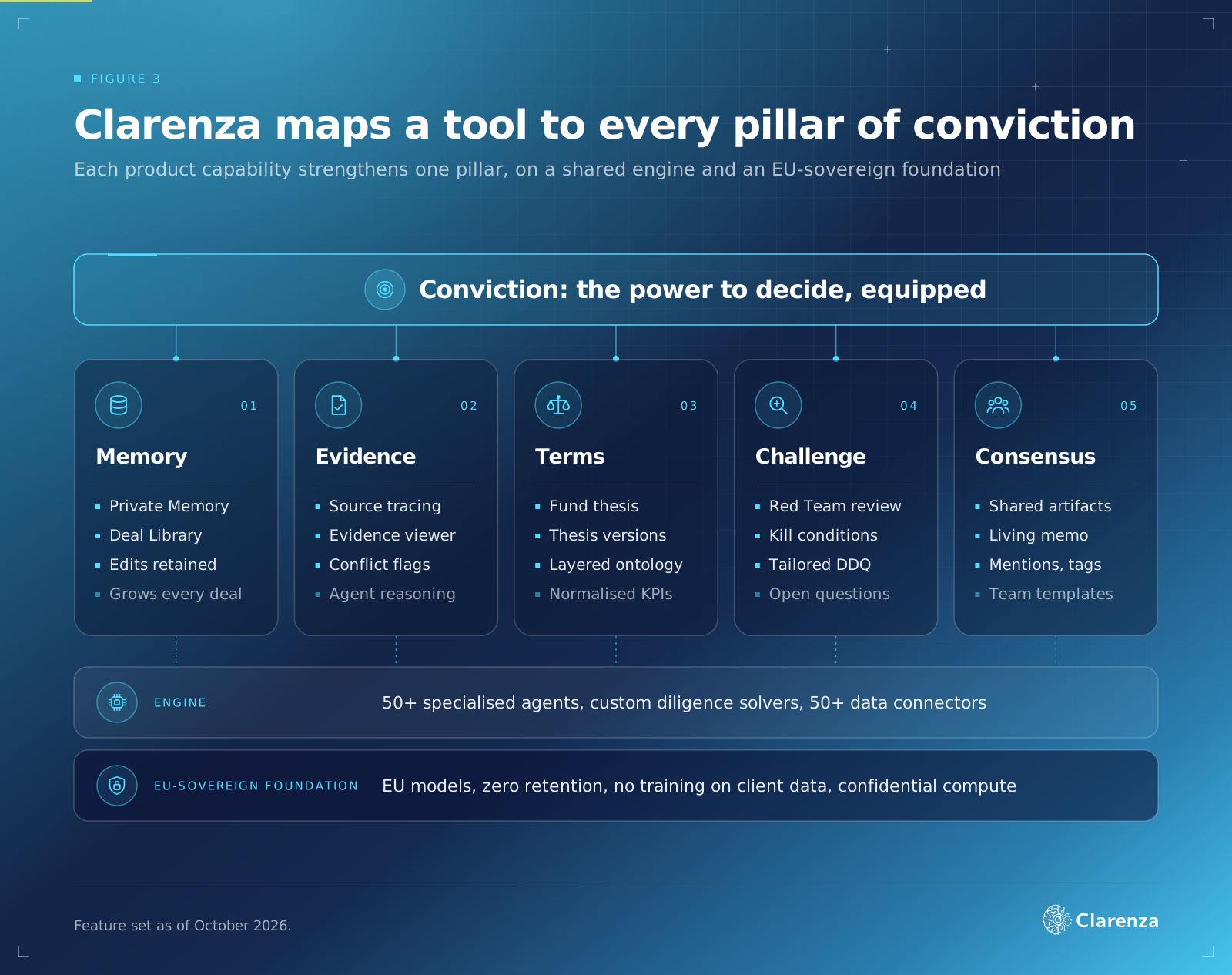
The Conviction Loop
Five thousand years separate the clay bulla from the evidence explorer, and the problem they solve has barely changed. Someone must commit capital before the future is known, and others must be able to trust that decision. Every tool in this series served that act. The bulla and the ledger gave it Memory and Evidence. The sea loan, the life table and the margin of safety gave it Terms. The Shang verification, the devil's advocate and the red team gave it Challenge. The naruqqum, the Delphi panel and the shared memo gave it Consensus.
What has changed is the speed, and the share of the work a machine can now carry. Reading a data room, reconciling its numbers and drafting the first version of a memo no longer need to consume an analyst's week. What has not changed is the act itself. The word judgment once meant the power to decide, and that power still belongs to the people who answer for the outcome.
The right design is therefore a loop, not a handoff. Evidence is gathered and traced. Assessments are structured against the firm's thesis. The counter-case is argued. People decide. Every edit, override and outcome flows back into the firm's memory, so the next decision starts better equipped than the last. That is how judgment compounds, and it is the loop Clarenza was built to run.
The question for the next decade is not whether AI will take part in investment decisions; it already does. It is whether firms will use it to think less, or to decide better. We would be glad to hear how your team is answering it.
If you would like to see the loop on your own deals, our beta is open: test Clarenza on your deals, free for 30 days.
References and Further Reading
Spreadsheets, terminals and buyouts
- University of Maryland. A Brief History of Spreadsheets
- Campbell, Actuarial Practice Forum, Society of Actuaries, 2010 (summarising Panko's field audits)
- Herndon, T., Ash, M. and Pollin, R. "Does High Public Debt Consistently Stifle Economic Growth?", PERI Working Paper 322, 2013
- US Senate Permanent Subcommittee on Investigations. JPMorgan Chase Whale Trades, 2013; JPMorgan Chase, Management Task Force Report, January 2013
- The Bloomberg Terminal, IEEE Spectrum
The decision-maker
- Meehl, P. Clinical versus Statistical Prediction (University of Minnesota Press, 1954)
- Grove, W. et al. "Clinical versus Mechanical Prediction: A Meta-Analysis", Psychological Assessment 12(1), 2000
- Tversky, A. and Kahneman, D. "Judgment under Uncertainty: Heuristics and Biases", Science 185, 1974
- Kahneman, D. and Tversky, A. "Prospect Theory", Econometrica 47(2), 1979; Nobel Prize 2002
- Janis, I. Victims of Groupthink (Houghton Mifflin, 1972)
- Tetlock, P. Expert Political Judgment (Princeton University Press, 2005); Tetlock, P. and Gardner, D. Superforecasting (Crown, 2015)
- Mellers, B. et al. "Psychological Strategies for Winning a Geopolitical Forecasting Tournament", Psychological Science 25(5), 2014
- Kahneman, D., Sibony, O. and Sunstein, C. Noise: A Flaw in Human Judgment (Little, Brown Spark, 2021); "How noisy is your company?", strategy+business; Kahneman et al. "Noise", HBR, October 2016
Model failures
- Federal Reserve History. Near Failure of Long-Term Capital Management; Lowenstein, R. When Genius Failed (Random House, 2000)
- Li, D.X. "On Default Correlation: A Copula Function Approach", Journal of Fixed Income, 2000; Salmon, F. "Recipe for Disaster: The Formula That Killed Wall Street", Wired, February 2009
- Financial Crisis Inquiry Commission. The Financial Crisis Inquiry Report, 2011
Engineering judgment
- Haynes, A. et al. "A Surgical Safety Checklist to Reduce Morbidity and Mortality in a Global Population", NEJM 360, 2009; Gawande, A. The Checklist Manifesto (2009)
- Klein, G. "Performing a Project Premortem", HBR, September 2007
- Lovallo, D. and Kahneman, D. "Delusions of Success", HBR, July 2003
- Britannica. Devil's advocate
- Lovallo, D. and Sibony, O. "The Case for Behavioral Strategy", McKinsey Quarterly, March 2010
- Kahneman, D., Lovallo, D. and Sibony, O. "Before You Make That Big Decision", HBR, June 2011; "A Structured Approach to Strategic Decisions", MIT Sloan Management Review, Spring 2019
- Gompers, P., Gornall, W., Kaplan, S. and Strebulaev, I. "How Do Venture Capitalists Make Decisions?", Journal of Financial Economics 135(1), 2020
- Gompers, P., Kaplan, S. and Mukharlyamov, V. "What Do Private Equity Firms Say They Do?", Journal of Financial Economics 121(3), 2016
AI-assisted decisions
- Agrawal, A., Gans, J. and Goldfarb, A. Prediction Machines (HBR Press, 2018); "When Prediction Gets Cheap", strategy+business
- Kasparov, G. "The Chess Master and the Computer", New York Review of Books, February 2010
- Dell'Acqua, F. et al. "Navigating the Jagged Technological Frontier", HBS Working Paper 24-013, 2023
- Brynjolfsson, E., Li, D. and Raymond, L. "Generative AI at Work", NBER Working Paper 31161, 2023 (published in QJE, 2025)
- Otis, N. et al. "The Uneven Impact of Generative AI on Entrepreneurial Performance", 2025
- Vaccaro, M., Almaatouq, A. and Malone, T. "When Combinations of Humans and AI Are Useful", Nature Human Behaviour 8, 2024
- Agarwal, N., Moehring, A., Rajpurkar, P. and Salz, T. "Combining Human Expertise with Artificial Intelligence: Experimental Evidence from Radiology", NBER Working Paper 31422
- Steyvers, M. et al. Calibration gap in AI-assisted answers, Nature Machine Intelligence, 2025
- Parasuraman, R. and Manzey, D. "Complacency and Bias in Human Use of Automation", Human Factors 52(3), 2010
- Dietvorst, B., Simmons, J. and Massey, C. "Algorithm Aversion", JEP: General 144(1), 2015; "Overcoming Algorithm Aversion", Management Science 64(3), 2018
- Kim, A., Muhn, M. and Nikolaev, V. "Financial Statement Analysis with Large Language Models", Chicago Booth, 2024
- Mateega, S. et al. "FinanceQA", arXiv, January 2025
- Bonelli, M. "The Adoption of AI by Venture Capitalists", HEC Paris working paper
Regulation
- European Commission. AI Act enters into force, 1 August 2024
- EIOPA. Digital Operational Resilience Act (applies from 17 January 2025)
- US Department of Justice. CLOUD Act resources